This article was originally published on islamsperspective.blogspot.com
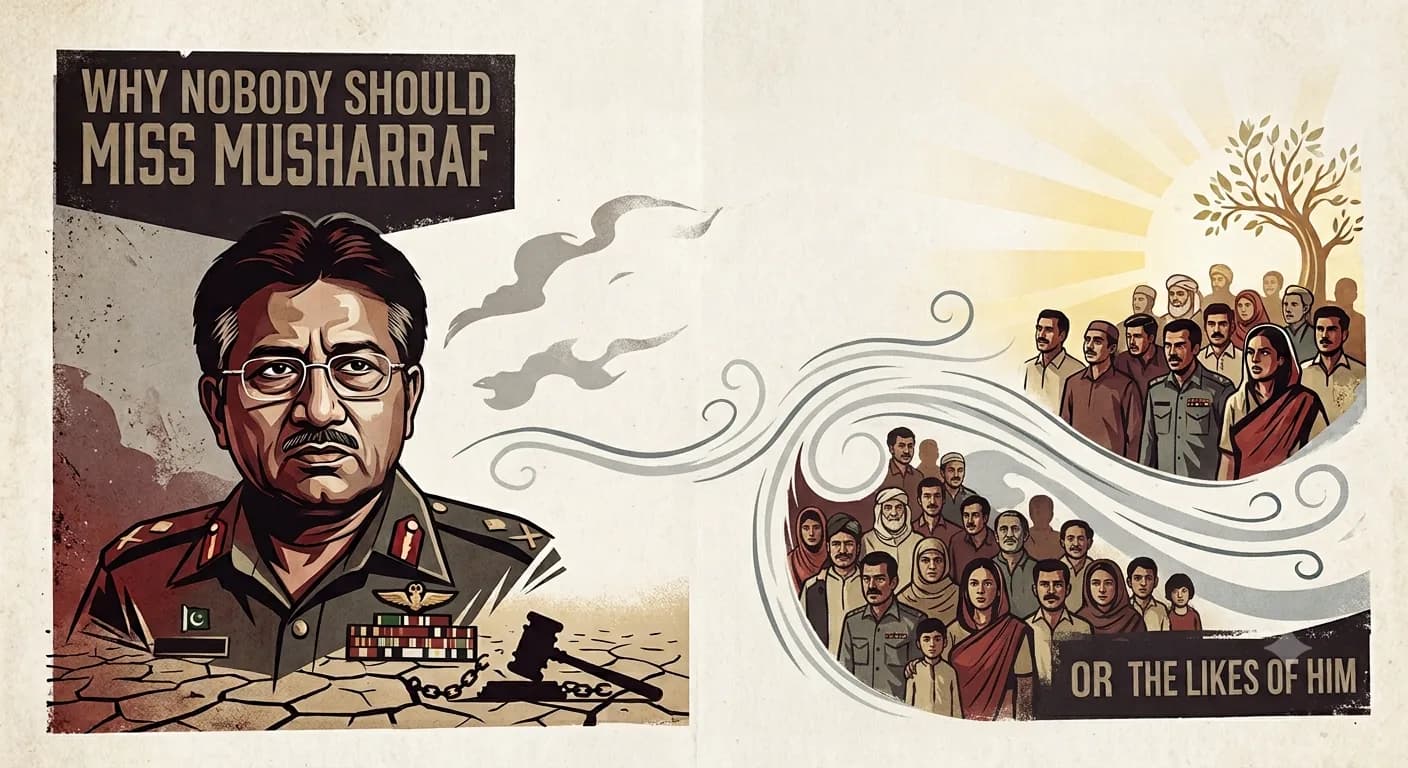
On 6th of January 2009, an article appeared in the daily 'The News' titled, "Why I miss Musharraf". It was written by a Lahore based lawyer, Salman Chima. Samad Khurram wrote in reply "Why I don't miss Musharraf" and set the record pretty much straight by pointing out the misdeeds of Musharraf which were either conveniently ignored by Mr. Chima or were portrayed in a different light altogether. I too strongly differ with the views of Mr. Chima articulated in his article but will try in this article to look at weakness of his conceptual framework rather than a point-by-point rebuttal of his claims.
First of all I would like to point out that the title chosen by Mr. Chima ('Why I miss Musharraf') would have been befitting if the policies of Mr. Musharraf had been reversed by his successors in power. As that is not the case, rather the issues kindled by Musharraf have under the guardianship of the current regime even flared up to devastating fires, there is no point in missing Musharraf in a figurative sense. The sacked judges are still out with no reinstatement in sight, American drones still attack and kill people in the NWFP and FATA regions, long hours of gas and electricity load-shedding continue throughout the chilling days and dark nights of winter, none of the missing people are recovered, we are still extending unstinted support to our staunchest allies, the Americans, our armies are still fighting our own people and last but not least we still have a dummy Prime Minister while our President has all the powers and the infamous 17th amendment hovers like the sword of Damocles over the elected assemblies.
Now coming to the conceptual fallacy, let me begin with asking what kind of comparison is this? For argument's sake, say if the current regime was worse than its predecessor, would that be a reason to miss and cherish the former? This twisted thinking reminds me of an anecdote in which a coffin-thief, while on his deathbed, requests his son to do something after his death due to which he would be remembered in high esteem by the community. The son adopted his father's profession, but with the difference that he would also mutilate the bodies which he would rob off their coffins. This way, people used to say, "His father was a good person, at least he won't mutilate the bodies". I hope this story clarifies the rational flaw of judging things based on a floating criterion. What would be 'bad' yesterday could be seen as 'good' today and what is 'bad' today might be judged as 'good' the next day.
The mention of criterion brings me to the second point, which is about the correct criterion to judge a regime or anything for that matter. I strongly feel that Muslims today, when it comes to choosing their rulers, employ the 'lesser of two evils' principle. It would be debatable whether or not this makes sense rationally, but there is no doubt that Islam does not allow us to choose any evil, especially not if it concerns ruling the affairs of Muslims. Similarly, while evaluating any previous performance of a government, the criterion is not who did the lesser damage to the country or which one was lesser evil, rather there must be a set standard by which we judge them. That standard or criterion is given to us by Islam and it manifested itself during the rule of Rasoolallah (saw), the righteous caliphs and those who followed them.
Time and again we have fallen prey to this fallacy of choosing the lesser evil thereby deteriorating our condition more and more. This has led to many today adopting a defeatist mentality, cherishing hollow words of our leaders. Just have a look at the recent stunt by the Turkish Prime Minister, Erdogan, who stormed out of a panel discussion after being upset by the fact that he had apparently been given less time to speak in rebuttal of Israeli President's case for the strikes on Gaza. As expected, not only did Erdogan receive a hero's welcome on the streets of Istanbul, but emails and video clips of Erdogan's walkout went around all over the Muslim world glorifying him. Don't these cherishers of Erdogan realize that actions speak louder than words? Turkey was the first Muslim country to recognize the illegal state of Israel and remains one of the few to not only have diplomatic but also trade relationships with her, despite her hands being constantly stained with Muslim blood.
Another such example of fooling the masses by staging an impressive diplomatic stunt was done by the late Pakistani Prime Minister, Zulfiqar Ali Bhutto, when on 15th of December 1971 he tore a UN Security Council Resolution saying he has been asked by his 11 year old son not to come back home with a document of surrender. What those who cherish him conveniently forget is that just a day after this PR stunt the Pakistani army surrendered to India.
I mention these examples so that we don't repeat the mistakes of our past — having the wrong criterion to measure good and bad, being satisfied with the lesser evil, and judging our rulers based on an emotional response to their 'heroic' behavior. Yes we are weak, because of these rulers, because of their treachery, because they don't leave any stone unturned to keep us disunited, because they help their colonial masters in plundering our resources, because they implement man-made systems on us and because they hate Islam and the Ummah loves it. Whereas if we were united under sincere Islamic leadership and systems, we would have been strong because of our belief, our numbers, our resources, our strategic geographical presence on the globe, and last but not least because we all want to enter Jannah by pleasing Allah (swt) by whatever it takes.